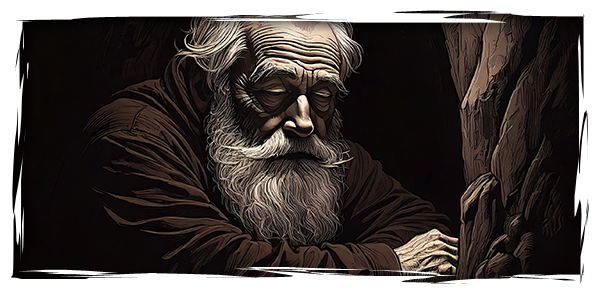
Abraham's Wall

“After these things the Lord’s message came to Abram in a vision: ‘Fear not, Abram! I am your shield and the one who will reward you in great abundance.’” –Genesis 15:1, NET

Let’s step back from Lot for a minute and rewind the clock. In chapter 14, Lot is swept up in the judgment of the rebellious five cities and taken captive (a preliminary warning from God). Abram hears of this, and with a few hundred men, chase down and defeat a much larger army, rescuing his nephew Lot (Gen 14:1-16). On Abram’s return, the mysterious “Melchizedek king of Salem,… priest of the Most High God,” to whom Abram gives “a tenth of everything,” comes out to greet Abram to perform holy communion (Gen 14:18-20). And then the king of Sodom offers Abram all the spoils. But Abram refuses to take anything, vowing that it is God alone who makes him rich (Gen 14:21-23).

It is here that Abram surely wondered who would do the same for him, especially since he had no other family to help (Gen 12:4). And this is the moment God declares to the faithful Abram, “I am your protector. I am your rewarder.”

There is a wall that God Himself “fortifies” (Psa 51:18) and “raises” (Exo 14:22)—the one around His people. It is the only wall that stands in the end (Rev 21:18), not of brick and stone, but the LORD manifesting Himself as a consuming fire (Zec 2:4-5). “The LORD’s deliverance, like walls and a rampart, makes [His people] secure,” (Isa 26:1). His people—those who love Him, demonstrating this by obeying Him (Joh 14:15), submitting to Him and drawing near Him—are so secure in His walls, that the enemy has no choice but to flee (Jam 4:7-8).

May we seek this wall alone to surround our lives and separate us from all those things hostile to God. May we draw security from this One source, never attempting to build or seek protection within any other fortification.

“You keep him in perfect peace whose mind is stayed on you, because he trusts in you.” –Isaiah 26:3, ESV

Foolish Walls

“Later the older daughter said to the younger, ‘Our father is old, and there is no man in the country to sleep with us, the way everyone does. Come, let’s make our father drunk with wine so we can go to bed with him and preserve our family line through our father.’” –Genesis 19:31-32, NET

“Sin makes us stupid!” (Tom Nelson).

Lot had long surrounded his family with a worldly focus (v.31) and resurrection-less mindset that had “corrupted good morals” and infected them all with the stupor of sin (1Co 15:32-34). Thus, his attempt to use cave walls to isolate and protect from the pain and evil presence in Zoar failed. The defiling sin of Sodom comes from within (Mat 7:15).

A wall is often a symbol of protection (ex: 1Sa 25:16), often a prideful one that God brings down (ex: Isa 25:11-12; Jos 6:1-5), especially those that protect only in the imagination (Pro 18:11).

“Day and night they walk around on its walls, while wickedness and destruction are within it.” –Psalm 55:10

See that these girls believed that there was “no man on earth” (v.31, ESV). They lived just as was taught by their father: by physical sight (Gen 13:10-11). If we “shelter” our children in a cave instead of under the protective hand of God, we do not insulate them from evil; we cut them off from the truth. If we teach our children law instead of faith, we set them up to take whatever practical fruit of false teaching is offered by Satan, quick to bite into the lie that God is withholding good things from them (Gen 3:4-6)? Without wisdom (fear of the Lord), we believe “God’s Word is not life to us, but law,” (John Bevere, “The Bait of Satan”).

What kind of foolish cave walls have we placed around us?

Have we not believed we kept our children safe from outside dangers by bringing them into the safety of our homes, only to hand them a virtual portal into godless worlds? Have we not placed fences around our playgrounds to protect our children from perpetrators, foolishly thinking we’ve confined innocence within the gates? Or consider our financial portfolios and 401(k)s that are fueled by unpredictable markets. We assemble agencies for our protection and fill them with prideful and selfish men, surprised when some turn criminal. We believe we can filter out evil, but not if sinful hearts lie on both sides.

What kind of foolish walls have you propped up?

“[The angel] brought me to the entrance of the court, and as I watched, I noticed a hole in the wall. He said to me, ‘Son of man, dig into the wall.’ So I dug into the wall and discovered a doorway. He said to me, ‘Go in and see the evil abominations they are practicing here.’ So I went in and looked. I noticed every figure of creeping thing and beast—detestable images—and every idol of the house of Israel, engraved on the wall all around.” –Ezekiel 8:7-10, NET

“Search me, O God, and know my heart; test me and know my anxious thoughts. See if there is any offensive way in me, and lead me in the way everlasting.” –Psalm 139:23-24, NIV

The Cave, Part 2

 “Lot went up from Zoar with his two daughters and settled in the mountains because he was afraid to live in Zoar. So he lived in a cave with his two daughters.” –Genesis 19:30, NET

Do not miss the opportunity to consider Lot’s situation and state of mind. He had a comfortable life of wealth and prominence (Gen 13:5-6; 19:1). His daughters were about to marry (Gen 19:14). He was well acquainted, and doubtless had many friends. And in one night he is dragged away, leaving everything behind. All his possessions, all his friends, his sons-in-laws, and now his wife—all lost, FOREVER! How would you feel?

Though God had compassion, Lot was hesitant to go (Gen 19:16). He did not fully trust the LORD, and thus appealed to stay close to the familiar (Gen 19:18-19). Yet when all was judged and removed from Lot’s life, Lot’s gratitude (v.19) was too shallow, and he harbored offense towards God. He turned to his last resort—himself, and fell into isolation and depression, willingly medicating his pain (v.33), and opening himself up to be used for nefarious purposes (vv.31-35; 2Ti 2:26).

If we do not trust in the LORD, we will seek safety among others, until they inevitably reveal themselves untrustworthy (Psa 146:3). Then who can we count on? All people deceive and betray (Rom 3:13), and change their minds (1Sa 15:29). Life itself is so brief and temperamental, those we love might depart us in an instant (Psa 89:47). So we build walls to protect ourselves, and shut out the inevitable pain community causes.

Yet we cannot fulfill our mission and grow in Christ in isolation (Mark 6:7; Luke 10:1). To attempt to “be fruitful and multiply” alone (Gen 1:28; Mat 28:19-20) is perverse—incest here is the picture (see also Lev 18:10). Love is the essential element of divine productivity, without which we achieve nothing (1Co 13:1-3). For love compels us to reach outward (1Co 13:4-7). We cannot love God and not love all those “fathered by him,” obeying all of God’s commands (1Jo 5:1-4), including the valuing of Christian community (Acts 2:42-47) and the love of our earthly enemies (Mat 5:44).

Do not forsake the assembly (Heb 10:25). If you have isolated yourself, reach out to a brother- or sister-in-Christ. If you know of a brother or sister in a cave, go to them today. Perhaps you can be as a divine messenger and take them by the hand and bring them out into the light of the risen Son.